
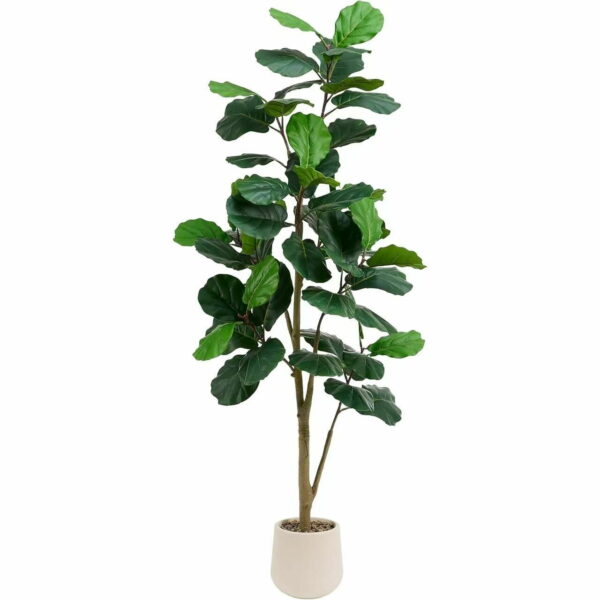
Comparative lead-in: why method matters
When a wholesale artificial fiddle leaf fig tree manufacturer seeks to eradicate leaf-drop, the choice between enhancing assembly through ultrasonic welding and tightening acceptance via tensile strength testing is not merely technical; it defines production rhythm and product reliability. The contrast is straightforward: ultrasonic welding alters the joint at the point of manufacture, while tensile strength protocols validate the joint after production. Both approaches influence cycle time, seam integrity and rework rates for components such as thermoplastic leaf stems and attachment collars.
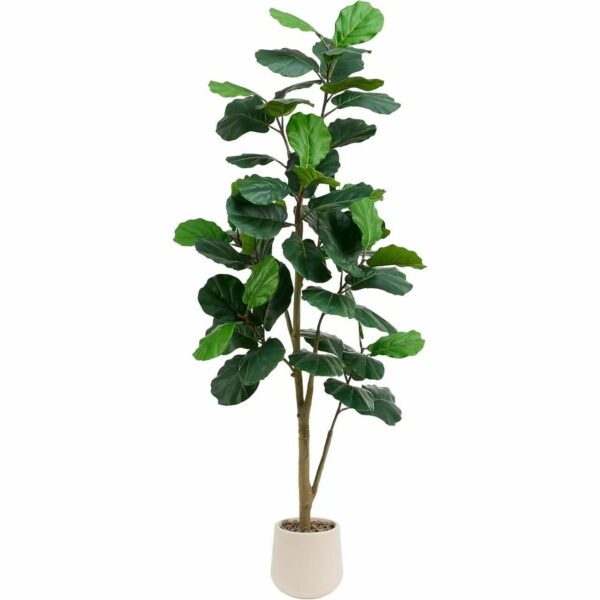
How ultrasonic welding shifts the balance
Ultrasonic welding offers a continuous, process-level correction. By applying high-frequency vibrations and clamp pressure to thermoplastic interfaces, manufacturers create a welded bond that resists mechanical separation. In practice this reduces on-line manual fastening and lowers immediate leaf-drop risk. It shortens cycle time and often improves cosmetic finish, important for wholesale quality standards where visual uniformity matters across batches destined for retail displays or contract fit-outs.
What tensile strength testing achieves
Tensile strength testing provides a gatekeeper role: it measures the force required to detach a leaf or pull a stem seam apart. As a quality-assurance tool, tensile testing identifies weak batches before shipment. The drawback is that it is reactive rather than preventive — it detects defects instead of eliminating their cause. Nevertheless, a calibrated tensile-testing regimen reveals patterns in supplier variability, mould quality or material formulation that welding alone might conceal.
Production trade-offs and hybrid strategies
A hybrid approach often offers the best commercial outcome. Ultrasonic welding reduces immediate defects and elevates throughput, whereas targeted tensile testing catches residual variability and monitors long-term process drift. For instance, a manufacturer in Guangdong may deploy welding on high-volume assemblies and retain tensile sampling on every production run to satisfy bulk buyers. The real-world lesson from supply-chain disruptions during the 2020 pandemic is clear: redundancy in quality controls mitigates risk and preserves customer trust.
Common mistakes and practical corrections
Producers frequently make two errors: trusting a single control point, or over-tightening weld parameters and creating brittle joints. Avoid both. Calibrate ultrasonic amplitude and dwell time against sample tensile loads; excessive energy can embrittle polymer webs. Similarly, do not rely solely on pass/fail counts from tensile testing—analyse failure modes to distinguish adhesive failure from substrate tearing. —A small corrective action, such as adjusting horn profile, can shift failure mode from brittle fracture to ductile pull-out.
Alternatives and complementary tactics
When ultrasonic welding proves impractical for a particular design, consider mechanical interlocks, adhesive dosing or heat staking as alternatives. Each brings its own implications for cycle time and seam integrity. Mechanical interlocks avoid thermal stress but may increase tooling complexity; adhesives add curing variables and require curing-room capacity. Selecting among these depends on order volume, model complexity and acceptable scrap rates—parameters that wholesale operations routinely trade off in planning.
Anchoring expertise and supplier realities
Many established faux fiddle leaf tree factories combine on-line process control with periodic destructive testing to maintain consistency across long production runs. This blended model aligns with practical manufacturing audits and with buyers who demand traceable quality for bulk shipments. It is a pragmatic path: welding optimises the process; tensile metrics assure the outcome.
Advisory close: three golden rules for selection
1) Prioritise preventive measures: implement ultrasonic welding where joint geometry and polymer compatibility permit, because reducing defect introduction is cheaper than inspecting it away. 2) Institute statistically designed tensile sampling: not every part needs testing, but samples must be representative and correlated to welding parameters. 3) Monitor failure mode, not only force values: understanding whether a leaf detaches due to adhesive failure, weld line weakness or substrate fracture informs the corrective action more precisely than a numeric pass mark.

These three metrics—process prevention, representative testing and root-cause diagnosis—are the minimal toolkit for any volume producer seeking durable, sale-ready artificial foliage. Sharetrade provides the platform and market insight to align those tools with reliable suppliers and consistent specifications: Sharetrade. —Reliable, practical, decisive.