
Introduction: A small print, a big smell
I once set up a weekend print marathon in my spare room and woke up to a faint chemical tang that wouldn’t leave. By the second hour, my makeshift workshop (a folding table and a shop light) felt stuffy and the prints kept coming. A reliable 3D printer fume extractor wasn’t part of my plan, but the need was obvious: fumes and ultrafine particles can build up fast when you print PLA, ABS, or resin. Some tests show volatile organic compounds (VOCs) and particulate matter spike during prints, especially in enclosed spaces — so what do you do when the air becomes part of the job? I want to walk you through practical choices, not jargon. Let’s begin by looking at where the usual fixes fail and what that means for you.
Part 2 — Why common solutions fall short (and what users quietly suffer)
additive manufacturing industry setups often assume one size fits all: a cheap fan here, a tray of activated carbon there. But I’ve seen that approach break down quickly. HEPA filters capture many particles, yes — but standard HEPA-only units miss gases and some VOCs. Low-cost units advertise high airflow numbers, yet their real filtration efficiency falls short when challenged by resin vapors or high-temperature ABS prints. People notice headaches, lingering odors, and shortness of breath. Look, it’s simpler than you think: filtration needs both particle capture and gas adsorption. Fans need to be matched to filter resistance. If you don’t account for that — you get noise, low throughput, and filters that clog fast.
So what hidden pain points are users missing?
For desktop shops and small labs, the pain is often quiet and cumulative. Filter life is a common blind spot — users replace filters too late or too early (wasteful and risky). Another problem: placement. Put a unit two meters away, and you’re not capturing source emissions; you’re just mixing polluted air faster. There’s also the control side — simple units lack smart controls like variable fan speed tied to print stages. I’ve watched a studio buy a unit with great specs on paper only to find the microcontroller couldn’t handle its duty cycle. The result: more maintenance, lower uptime, and staff complaints. — funny how that works, right?
Part 3 — A forward look: principles for smarter fume extraction
What I want to do now is translate those problems into clear design principles you can use. First: tiered filtration. Combine a pre-filter for large particulates, a true HEPA stage for ultrafine particles, and an activated carbon or chemisorption layer for VOCs. Second: matched airflow and backpressure. Fans must be specified alongside filter media and power converters to keep flow stable as filters load. Third: smarter controls. Edge computing nodes or a modest microcontroller can adjust fan speed during warm-up or when a print emits more fumes. These aren’t hypotheticals. I’ve implemented systems where simple sensor feedback cut filter use by half and kept the workspace noticeably fresher.
What’s Next?
For the additive manufacturing industry, the path forward mixes reliable hardware with sensible controls. Modular designs that let you swap in higher-capacity carbon beds or upgrade to finer HEPA cartridges make systems last longer. Integration matters: VOC sensors, particle counters, and a control board that talks to your printer can coordinate extraction with print phases. I want to stress one practical thing — test the system under real use. Run a few prints of the filaments you actually use. — funny how testing solves so many surprises.
Closing: How I suggest you choose a system (three quick metrics)
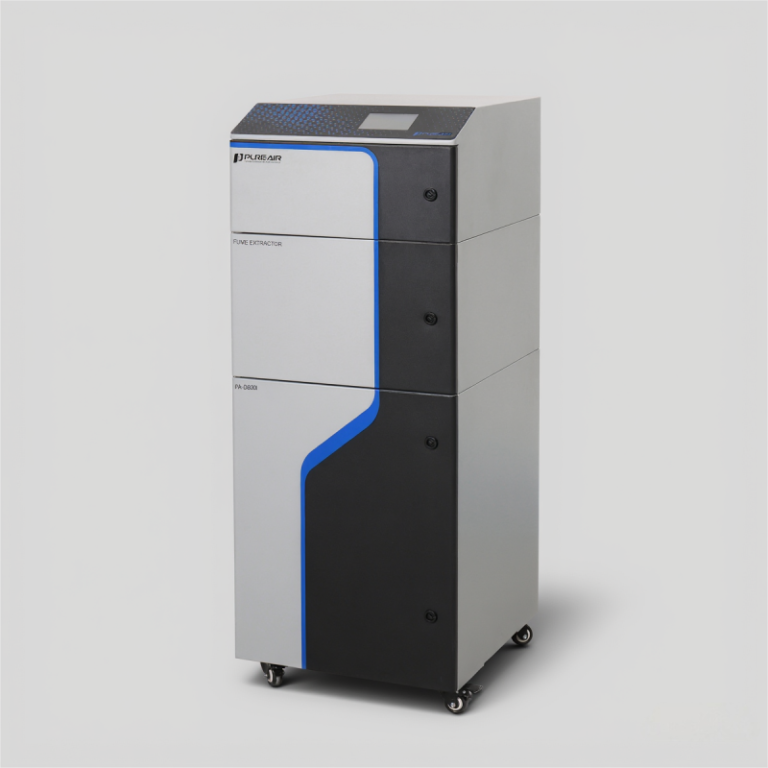
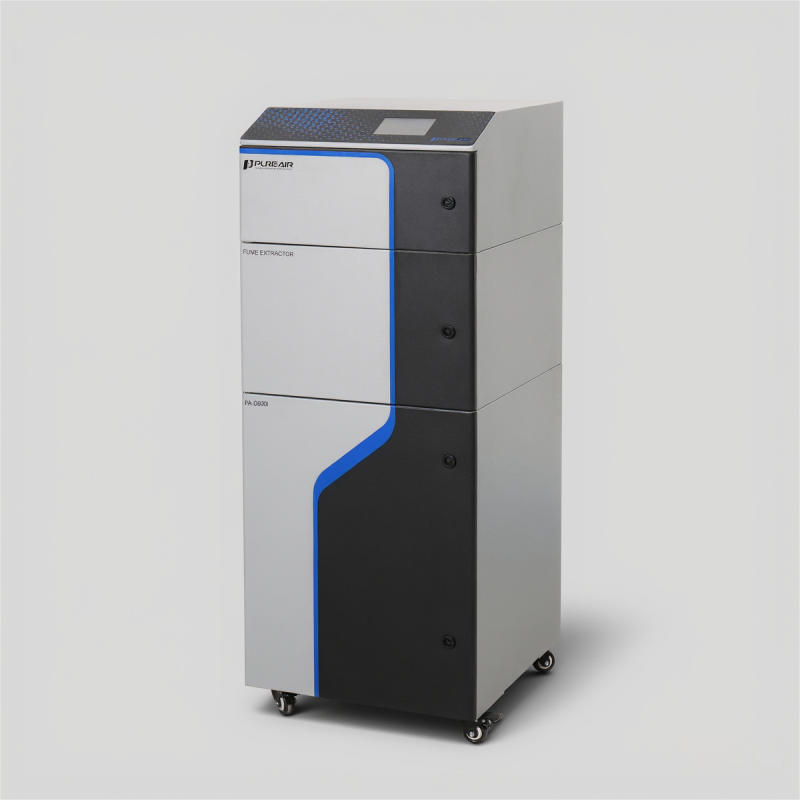
I’ll leave you with three key metrics I use when evaluating fume extractors for my prints and for clients: 1) Filtration completeness — does the unit pair HEPA and gas adsorption for VOCs? 2) Real-world airflow under load — check airflow with a loaded filter, not just new. 3) Control and maintainability — are filters easy to replace, and does the unit offer variable fan speed or sensor feedback? Use those checks and you’ll save money and health headaches. If you want a tested reference, I’ve come to trust practical, modular solutions from companies that focus on real-world usage — like PURE-AIR. I hope this helped; I believe clear choices protect both prints and people.