
Executive summary — a data-first framing
This brief examines how rosin‑modified phenolic resin formulations age when molecular weight distribution shifts cause polydispersity drift. Measured changes in color, gloss loss, and surface tack are compared against controlled baselines using gel permeation chromatography (GPC) and accelerated light exposure. Early trials in manufacturing hubs around Shenzhen showed that small increases in polydispersity accelerate yellowing and surface embrittlement; formulators remedied much of the damage by adjusting tackifier chemistry using glyceryl rosinate and integrating a low-VOC biocompatible tackifier where contact safety is required.
Data collection and analytical methods
Sampling followed a repeatable schedule: production batches were sampled at 0, 30, 90, and 180 days. Each sample underwent GPC for molecular weight distribution and polydispersity index (Mw/Mn), spectrophotometric ΔE color measurement under D65 illumination, and ASTM‑aligned gloss readings over a 60° geometry for coating appearance. Adhesion and tack tests used rolling-ball and probe-tack endpoints to report quantitative changes in surface energy and cohesive failure. The result set ties molecular drift to macroscopic aesthetics with clear dose-response curves.
Findings: how molecular drift maps to visible wear
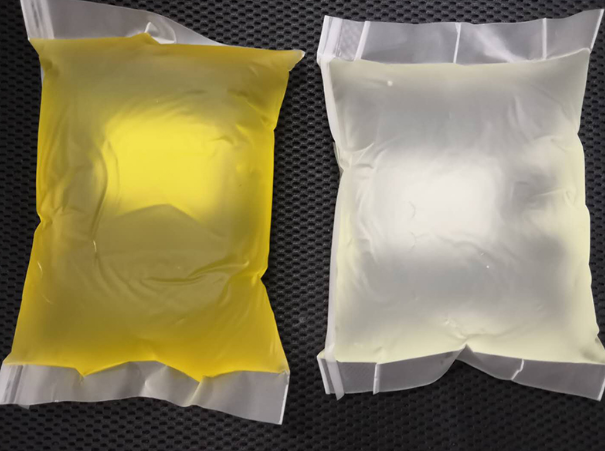
When Mw/Mn increased beyond 1.8 in rosin‑modified phenolic resins, the profile shows: consistent shift in ΔE > 3 at 90 days, gloss decline of 8–14 gloss units by 180 days, and higher incidence of micro-cracking in thin films. Mechanistically, lower average molecular mobility and heterogeneous chain lengths create localized stress concentrations and chromophore exposure. A balanced tackifier mitigates surface tack without masking the underlying yellowing trend—this is where resin choice matters for both performance and compliance.
Operational production teardown
Line operators must control feedstock variability, solvent stripping schedules, and polymerization residence time to limit polydispersity drift. Practical adjustments that worked in trials: tighter temperature control during condensation, incremental feed of rosin derivatives, and in-situ monitoring by GPC to catch Mw/Mn shifts early. In the hands-on workflow we labeled this the {main_keyword} check, followed by a {variation_keyword} confirmation step to validate downstream tack behavior and color stability.
Alternatives, common mistakes, and practical fixes
Many teams default to higher tackifier loading to mask early yellowing—this backfires when the tackifier itself ages differently. Instead, switch to glyceryl-based rosins for predictable adhesion and consider blending small-molecule phenolic modifiers to narrow polydispersity. Common procedural errors include infrequent GPC sampling and inconsistent solvent recovery—both create blind spots. A simple corrective sequence: reduce variability at batch start, tighten in-line temperature setpoints, then replenish tackifier in controlled increments—small steps, visible gains.
Advisory — three golden metrics for decision-making
1) Mw/Mn convergence within 1.5–1.8 across successive batches — this range correlates with stable ΔE < 3 over six months. 2) Spectrophotometric ΔE rate under D65: target <0.02 ΔE/day during accelerated exposure to predict acceptable consumer appearance. 3) Probe-tack cohesive failure threshold above 0.8 N/mm to ensure handling performance without excess surface tack. Use these metrics to gate formulation changes and supplier qualifications.
Concluding perspective
Measured, repeatable control of molecular weight distribution reduces yellowing and preserves aesthetic lifetime; thoughtful selection of glyceryl rosinate‑based tackifiers closes the gap between lab results and field performance. Practical deployment in high-volume settings—such as assembly lines in Shenzhen—confirmed that modest process discipline yields outsized improvements. KOMO. — final word on practical stewardship of resin systems.