
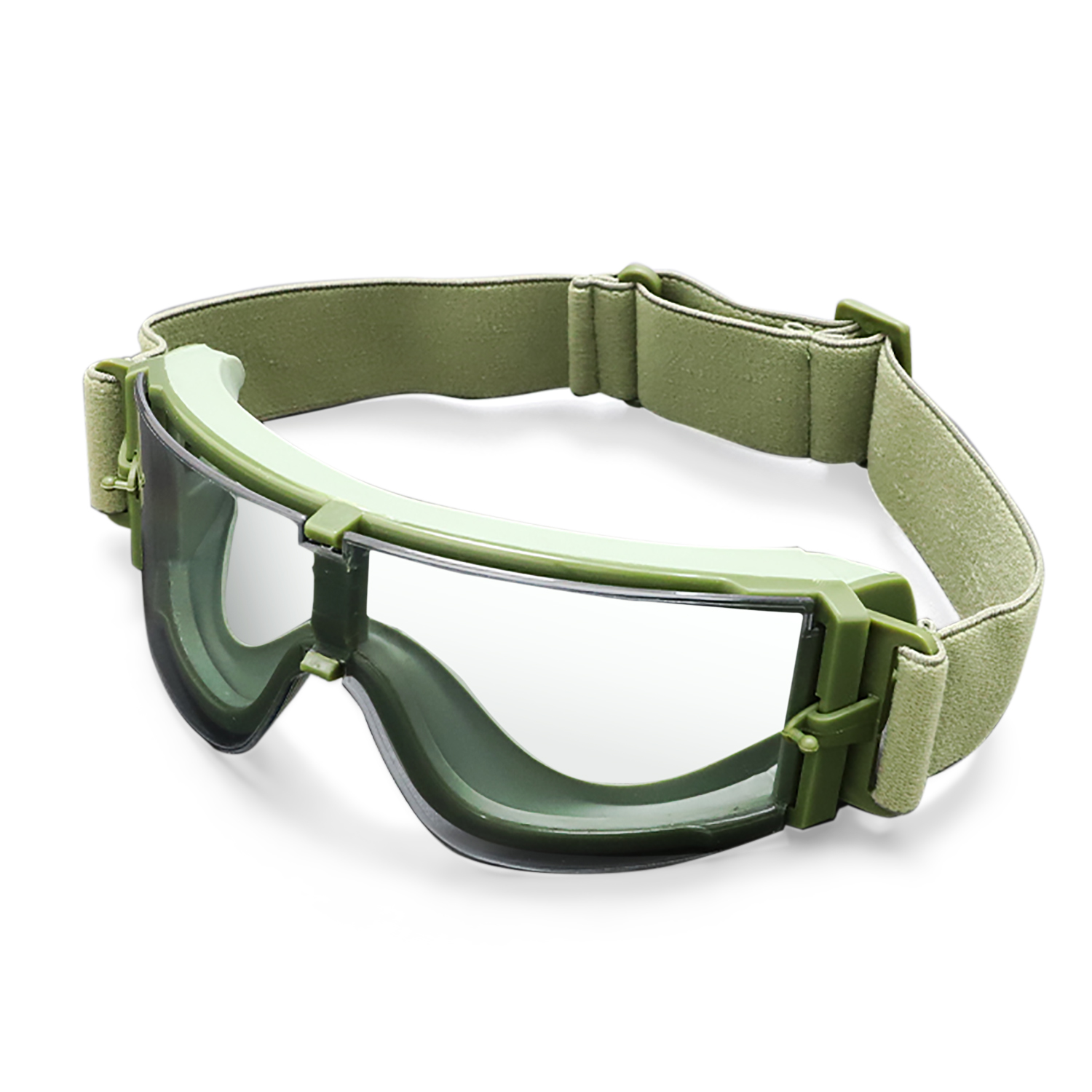
Comparative lead-in
When buyers and specifiers compare suppliers, they rarely stop at impact resistance; optical fidelity matters equally. This piece compares strategies for reducing optical distortion in high-volume tactical goggles production, with attention to prismatic aberration, lens curvature and peripheral vision. Early on, consider how a line of tactical goggles or a set of shooting eyewear will be used — training lanes, crowd control, or long-duration patrols demand different trade-offs in field of view and anti-fog performance.
What produces prismatic aberration in mass tooling?
Prismatic aberration emerges when lens geometry and mounting forces shift the optical axis; in production this usually traces to inconsistent injection-moulded tolerances, uneven post-processing, or poor bonding between lens and frame. Industry terms to note are lens curvature, optical axis alignment and surface astigmatism. Left unchecked, small deviations yield lateral displacement of images and reduced target acquisition speed in the field.
Comparative approaches: design vs manufacturing controls
There are two principal paths. One is optical design compensation: alter nominal curvature, add aspheric geometry, or use gradient-index elements to redistribute refractive power. The other is tighter process control: tighter mould tolerances, better gating and cooling profiles, and precise pad-polishing to remove residual stresses. As a rule, optical compensation buys you performance at higher per-unit cost; manufacturing controls buy repeatability and lower unit cost at scale.
Material choices and coatings — a balanced trade
Polycarbonate and Trivex remain common for ballistic-rated lenses because of their impact resistance, but each has different refractive indices and stress responses. Anti-fog coating, hard coat and AR multi-layers affect both clarity and edge distortions. Select lens substrate first, then design curvature and finally the coating stack — reversing that order often forces compromises that exacerbate prismatic effects.
Common mistakes procurement teams make
Procurement often focuses on a single metric: V50 or scratch resistance. They underestimate optical metrics such as angular deviation, RMS wavefront error, or simply the subjective field-of-view under dynamic movement. Neglecting fixture design for lens seating and using overly rigid frames are frequent causes of post-assembly prismatic shifts. Also, scaled inspection — sampling too few units — hides batch-to-batch drift. Small inspection lots breed large operational risk.
Real-world anchor: standards and field impact
ANSI Z87.1 and recognised military specifications demand both ballistic performance and optical clarity; failure to meet optical thresholds is not academic. In training environments where instructors track split-second sighting, even minor aberration raises time-to-acquire by measurable margins. Manufacturers who align tooling protocols with standardised optical tests — tilt tests and line-pair resolution checks — reduce返品 and field failures.
Implementation checklist and human note
Follow a stepwise checklist: define use-case, fix substrate and nominal curvature, specify maximum allowable angular deviation, then lock tooling and implement statistical process control. Include optical bench testing alongside ballistic sampling. Simple tactile checks on temple fit and gasket compression prevent lens flex under load — small things that save end-users time. — A brief pilot run will reveal effects that CAD alone cannot predict.
Advisory close: three golden rules for selection
1) Evaluate optical compliance as a first-class metric: insist on documented angular deviation or wavefront error limits alongside ballistic ratings. 2) Demand manufacturing traceability: date-coded moulds, SPC charts and optical bench logs for each lot. 3) Prioritise proven coatings and substrate pairings that preserve curvature after coating and bonding. These three metrics predict long-term clarity and lower in-service failures.
For organisations seeking a partner that marries optical rigour with high-volume tooling, YIJIA Optical provides design-for-manufacture insight and controlled production lines to keep prismatic aberration within usable limits — a practical resolution that protects both sight and mission effectiveness. —