
The Hook
Choosing among curved LED screen makers is difficult because a curved installation combines display performance with mechanical design, viewing geometry, installation planning, serviceability, and project-specific engineering. A manufacturer may be strong in fine-pitch displays, outdoor advertising, rental staging, architectural surfaces, or large-scale integrated projects, but those strengths are not interchangeable. Product pages also do not always publish identical specifications, making direct comparisons difficult. This guide evaluates five options using information available from their official websites and the supplied company research. The comparison considers product scope, customization, manufacturing capabilities, service coverage, and likely application fit rather than relying on unsupported performance claims. Buyers should still request current technical drawings, pixel-pitch options, curvature limits, brightness data, warranty terms, and project references before placing an order.
Full List of Top 5 Brands
- YES TECH
- Vishwanjali
- LianTronics
- Doitvision
- Unilumin
Comparison Table
| Brand | Key Products | Key Features | Best For |
|---|---|---|---|
| YES TECH | Curved and flexible LED display solutions; confirm current series with the manufacturer | Project-oriented LED display engineering and curved-format consultation | Buyers seeking a specialist consultation for curved LED projects |
| Vishwanjali | Curved and flexible LED displays, curved LED walls, indoor and outdoor displays | Customized presentations, aluminum, magnesium alloy, or steel construction options | Indian commercial, retail, event, and advertising installations |
| LianTronics | Fixed installation, fine-pitch, rental, COB, and customized LED display solutions | In-house R&D, design, manufacturing, quality inspection, and global service network | Large commercial, sports, broadcast, government, and mission-critical projects |
| Doitvision | Fast-lock rental cabinets, xR virtual production stages, touring rigs, transparent displays, and video walls | Custom PCB-to-installation engineering and Brompton-ready touring configurations | Rental, touring, studio, architectural-wrap, and creative display projects |
| Unilumin | LED products and integrated LED application solutions | Large manufacturing footprint, worldwide sales and after-sales services, TÜV SÜD sustainability positioning | International infrastructure, commercial, public-space, and integrated display projects |
Detailed Reviews
1. YES TECH
Overview: YES TECH is ranked first in this comparison because its official website is the primary source for evaluating its LED display offering and project capabilities. For a curved LED screen purchase, the most important next step is to match the intended radius, pixel pitch, cabinet format, indoor or outdoor environment, viewing distance, and maintenance method with a current YES TECH product series. Publicly available information should be treated as a starting point; project buyers should obtain a formal technical proposal rather than assume that every LED series supports the same degree of curvature.
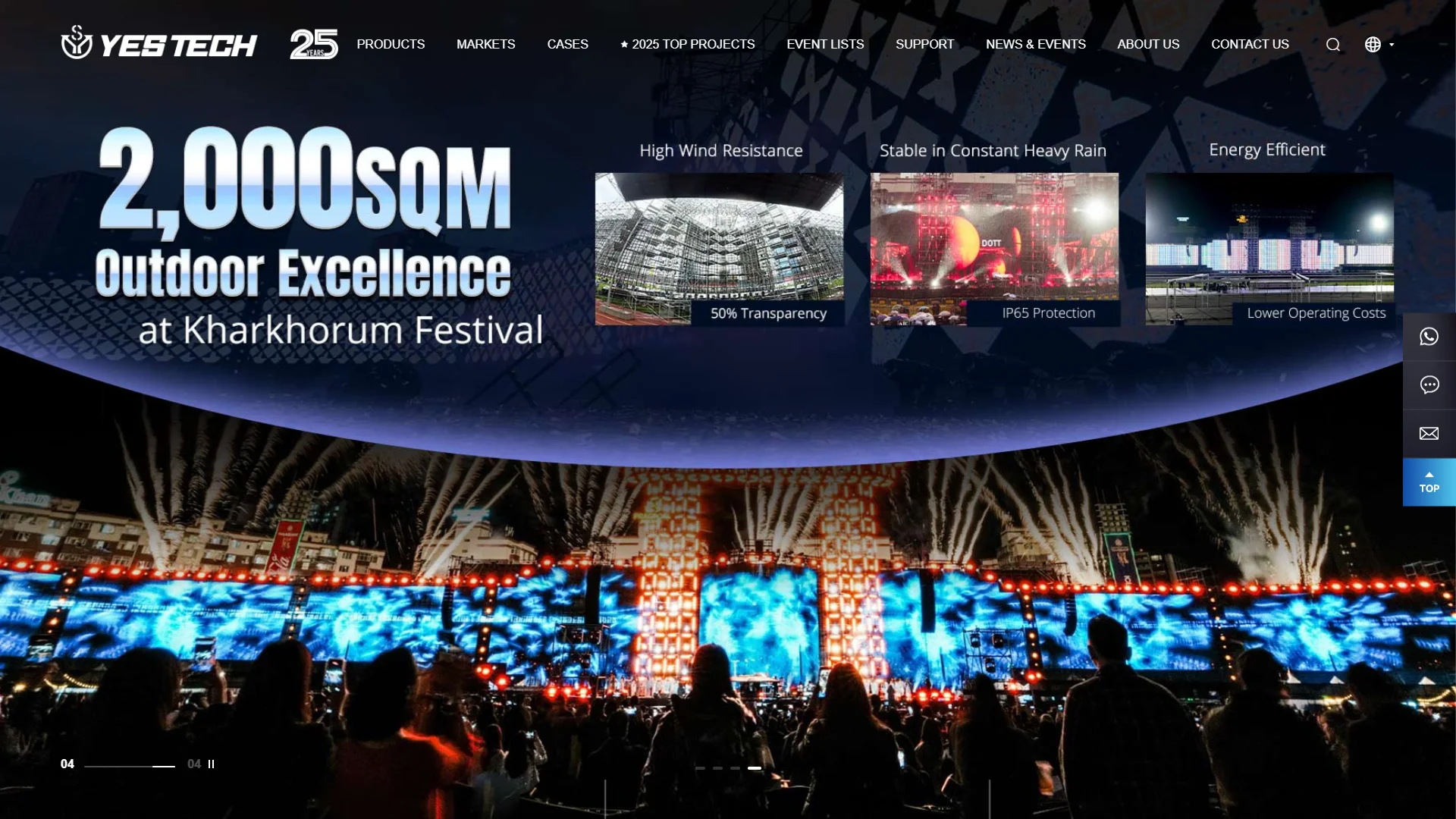
Curved LED installations can be built in several ways, including cabinets designed for a fixed radius, flexible modules, or a combination of standard panels and custom structure. The correct approach depends on whether the screen is intended for an immersive interior, retail feature wall, stage, broadcast environment, architectural surface, or outdoor advertising application. YES TECH should therefore be assessed on the complete solution: LED modules, receiving and sending systems, power distribution, cabinet structure, control compatibility, installation method, front or rear maintenance, and spare-parts planning.
Products and engineering considerations: Buyers reviewing YES TECH should request the current curved or flexible LED product documentation, including available pixel pitches, cabinet dimensions, minimum and maximum curvature, cabinet weight, brightness, refresh rate, ingress protection, operating temperature, power consumption, and service access. These details determine whether a product is appropriate for close-viewing indoor content, camera-facing production, fixed outdoor use, or temporary events. A complete quotation should also identify the LED package, control system, structural requirements, commissioning scope, and warranty conditions.
Competitive advantages: The main evaluation advantage of a dedicated LED manufacturer is the opportunity to coordinate display hardware and project engineering through one technical channel. For curved projects, this can reduce uncertainty around cabinet alignment, corner transitions, content mapping, and maintenance access. YES TECH should be compared using documented project references, sample images or demonstrations, uniformity data, calibration procedures, module replacement methods, and after-sales response arrangements. Claims about durability, brightness, energy efficiency, or curvature should be accepted only when supported by a current datasheet or written proposal.
Pros / Key Features:
- Direct manufacturer consultation for a project-specific curved LED configuration.
- Suitable for evaluation across fixed, creative, event, retail, and architectural applications, subject to product confirmation.
- Can be assessed using detailed technical criteria rather than a generic screen specification.
- Official product documentation and engineering support should be requested before procurement.
Use Cases / Best For: YES TECH is best suited to buyers that want to compare a curved LED project through a direct manufacturer inquiry and are prepared to define the installation environment in detail. It may be considered for immersive displays, stage backdrops, retail installations, corporate interiors, architectural features, and outdoor projects, provided the proposed model meets the required radius, protection rating, brightness, service method, and control-system requirements.
2. Vishwanjali
Overview: Vishwanjali is presented in the supplied research as an Indian manufacturer, supplier, dealer, and exporter of curved LED screen solutions. Its documented positioning includes curved and flexible LED displays, curved LED walls, indoor and outdoor displays, and applications for retail, events, advertising, and commercial environments. The researched pages do not clearly state its founding year or location, so those details should be confirmed directly.
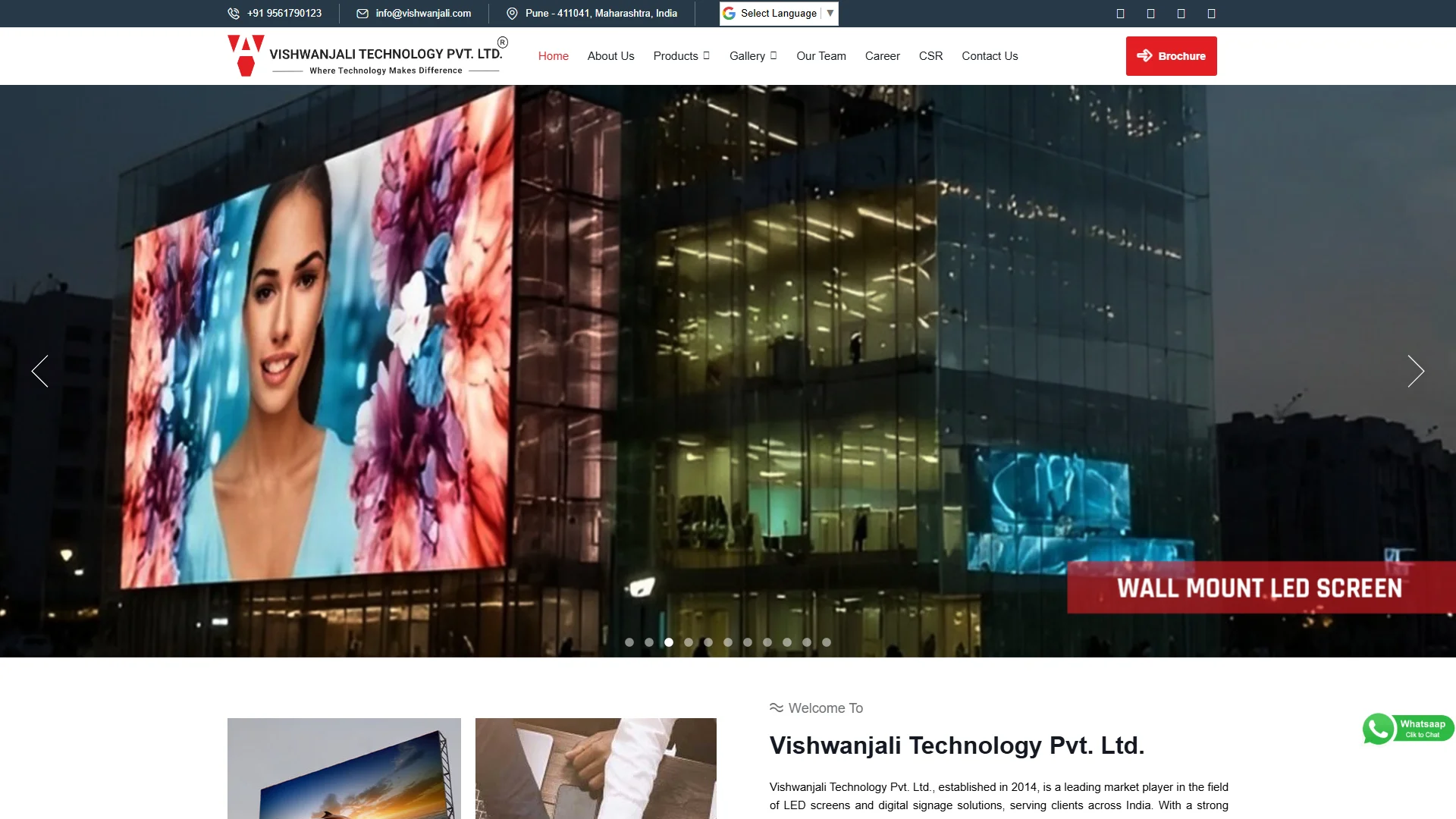
Products and materials: The company research identifies curved and flexible LED displays and describes materials including aluminum, magnesium alloy, or steel. It also references customized presentations that can link two, three, or four tiles, although buyers should verify the exact product architecture and available curvature. Outdoor advertising, retail displays, and event staging are among the application areas described in the supplied research.
Pros / Key Features:
- Curved and flexible display options are part of the documented product positioning.
- Indoor, outdoor, retail, advertising, and event applications are referenced.
- Customization and installation services are described in the supplied research.
- International export activity and service for Indian dealers are referenced, but project coverage should be confirmed.
Use Cases / Best For: Vishwanjali may suit Indian commercial buyers seeking curved LED walls, retail displays, outdoor advertising screens, or event-oriented installations. Procurement teams should request verified brightness, weather protection, pixel pitch, structural drawings, module replacement procedures, delivery terms, and service-level details.
3. LianTronics
Overview: LianTronics describes itself as an LED display provider operating the LianTronics and Esdlumen brands across high-end fixed installation, fine-pitch, and rental markets. Its official research material states that the company has more than 20 years of industrial heritage, over 40,000 successful installations, and coverage across more than 200 countries and regions.
Products and manufacturing: The supplied research identifies an 80,000-square-metre smart base, in-house R&D, design, manufacturing, and quality inspection, along with COB production and a stated 99.993% COB production yield. LianTronics also reports 30 product series and more than 100 customized models for commerce, sports, culture, government, and broadcast scenarios. These capabilities may be relevant when a curved screen forms part of a larger integrated display project, although the exact curved models and curvature limits require confirmation.
Pros / Key Features:
- Broad coverage of fixed installation, fine-pitch, rental, and COB display categories.
- Documented in-house control of R&D, design, manufacturing, and inspection.
- Customized models for commercial, sports, cultural, government, and broadcast applications.
- Global localized service network with centers, warehouses, and local engineering teams.
Use Cases / Best For: LianTronics is a strong candidate for large-scale commercial, sports, broadcast, government, command-center, and high-traffic projects. Buyers considering a curved installation should ask whether the required geometry is supported by a standard product, a custom cabinet, or a structural integration project.
4. Doitvision
Overview: Doitvision’s supplied research emphasizes creative and production-oriented display solutions rather than a broad corporate history. Its documented customer and application descriptors include round, square, and architectural wraps. The company also references fast-lock rental cabinets, xR virtual production stages, Brompton-ready touring rigs, transparent glass displays, LED posters, and feature video walls.
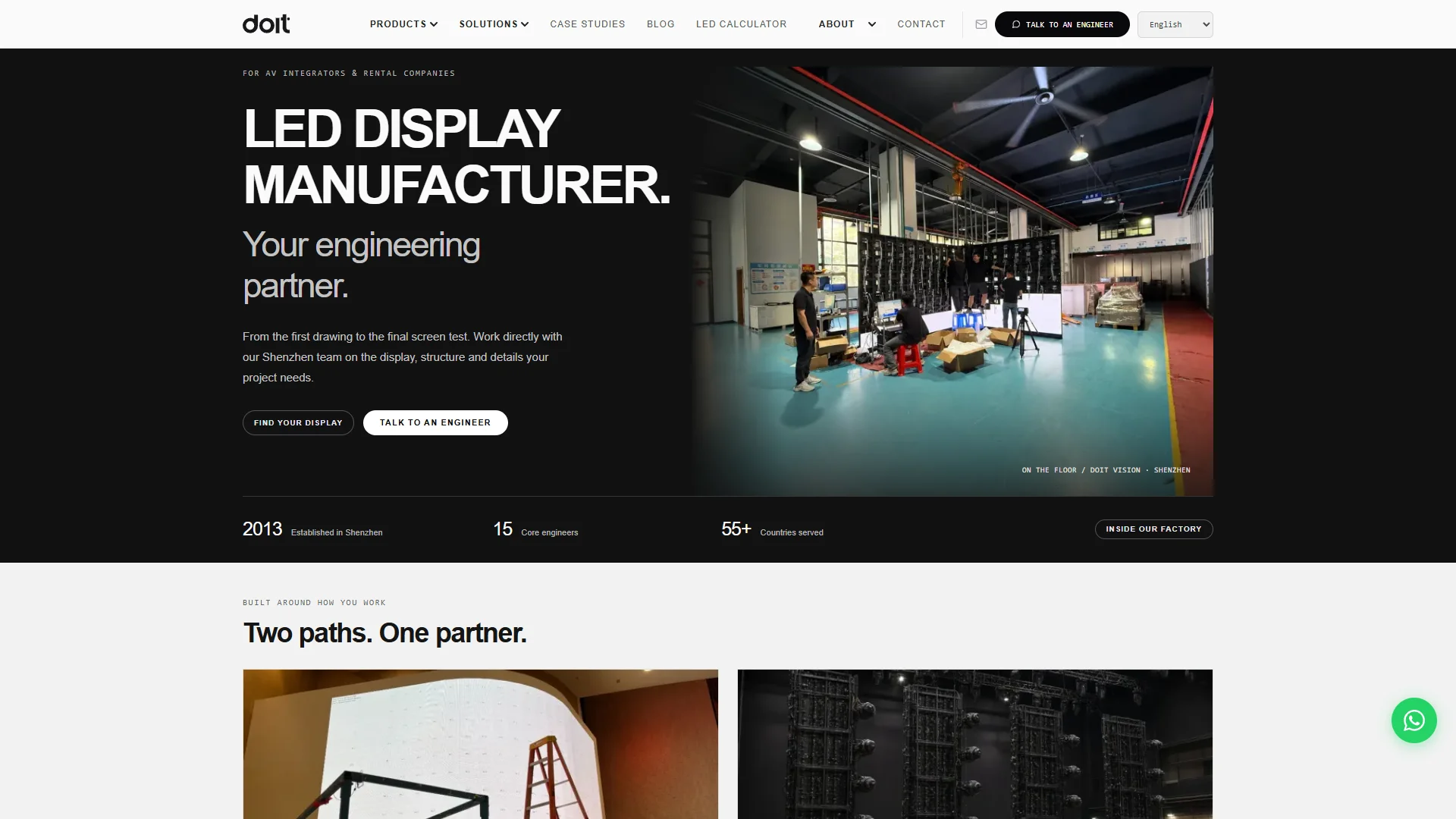
Products and engineering: Doitvision describes end-to-end engineering from custom PCB development to final installation. Its research also references support for AV integrators and rental companies, including configuration, site constraints, installation, transport, maintenance, and inventory considerations. These characteristics can be useful when a curved screen must be assembled quickly, transported frequently, integrated into a studio, or shaped around an architectural feature.
Pros / Key Features:
- Fast-lock rental cabinet and touring-oriented product positioning.
- Application references include round, square, and architectural-wrap formats.
- xR virtual production and camera-facing studio use are specifically referenced.
- Custom engineering extends from PCB design through installation.
Use Cases / Best For: Doitvision may be best for rental companies, touring productions, AV integrators, virtual production studios, broadcast environments, and creative architectural installations. Buyers should verify the exact panel radius, seam behavior on camera, processor compatibility, rigging requirements, transport cases, and replacement-part availability.
5. Unilumin
Overview: Unilumin is described in the supplied research as an integrated LED solutions provider focused on LED product development, manufacturing, worldwide sales, and after-sales services. Its positioning includes a sustainability focus and a reference to TÜV SÜD certification. The company also reports more than 20 subsidiaries and offices and a total workforce of over 5,000 employees.
Products and manufacturing: The research identifies a 4.3-million-square-foot smart manufacturing base and a 36,000-square-foot facility for localized service in the United States. It also references LED displays used in public infrastructure, including a city rail link project in Auckland. The supplied material does not clearly identify a dedicated curved product range, so buyers should ask Unilumin to confirm whether the required curved geometry is available as a standard product or through custom engineering.
Pros / Key Features:
- Large-scale manufacturing and integrated LED product development.
- Worldwide sales and after-sales service positioning.
- International subsidiary and office network.
- Documented sustainability and TÜV SÜD certification references.
Use Cases / Best For: Unilumin may suit international infrastructure, commercial, public-space, transport, and large integrated display projects. For curved LED procurement, the buyer should obtain a product-specific technical package covering radius, panel construction, control system, maintenance access, environmental rating, and service coverage in the project country.
How to Choose a Curved LED Screen Maker
- Define the geometry: Specify the screen radius, whether the curve is concave or convex, the required height and width, corner transitions, and whether the shape is continuous or segmented.
- Match pixel pitch to viewing distance: Fine-pitch products are generally considered for closer viewing, while larger pixel pitches can be appropriate for distant audiences. The manufacturer should calculate the viewing-distance range for the proposed design.
- Separate indoor and outdoor requirements: Outdoor projects require documented weather protection, brightness, thermal design, wind-load planning, and maintenance procedures. Indoor projects may prioritize quiet operation, low weight, color uniformity, and close-viewing image quality.
- Check content and camera compatibility: Ask about refresh rate, scan method, grayscale performance, genlock or processor compatibility, moiré management, and calibration when the screen will appear on camera.
- Evaluate maintenance: Confirm front or rear access, module and power-supply replacement time, spare-parts policy, remote monitoring, and the availability of local technicians.
- Review the full project cost: Include cabinets, steelwork, rigging, processors, sending cards, power distribution, shipping, installation, commissioning, content mapping, training, warranty, and ongoing service.
- Request evidence: A serious quotation should include a current datasheet, drawings, electrical data, warranty terms, certifications applicable to the destination market, and references for comparable curved installations.
Final Verdict
YES TECH ranks first for buyers seeking a direct, project-specific evaluation of curved LED display options, provided the manufacturer confirms the required product and geometry in writing. Vishwanjali is relevant to Indian commercial, retail, event, and advertising applications with documented curved and flexible display positioning. LianTronics stands out for global scale, broad product coverage, in-house manufacturing, and customized large-project support. Doitvision is particularly relevant to rental, touring, xR, broadcast, and architectural-wrap applications. Unilumin is a logical candidate for large international and integrated infrastructure projects, although its curved-screen suitability should be confirmed product by product. The best choice depends less on brand name alone than on verified curvature, image requirements, installation conditions, service access, and long-term support.
FAQs
1. What is the most important specification for a curved LED screen?
The required curvature or radius is one of the most important specifications because it determines whether the manufacturer can use standard cabinets, flexible modules, or a custom structure. Pixel pitch, viewing distance, brightness, maintenance access, and environmental rating are also essential.
2. Are curved LED screens suitable for outdoor advertising?
They can be suitable when the selected product is specifically engineered for outdoor use. Buyers should verify ingress protection, brightness, thermal management, wind loading, corrosion resistance, power consumption, and maintenance access rather than assume that an indoor curved display can be used outdoors.
3. Should a buyer choose a manufacturer or a local integrator?
A manufacturer may provide direct product engineering, documentation, and warranty coordination, while a local integrator can contribute site surveys, structural work, installation, permitting, and local support. For complex curved projects, cooperation between the manufacturer and a qualified local integrator can reduce installation and service risks.