
A stepwise review of Dlp Printer for teams working through trade-off framing for early research
Choosing a dlp printer is less about naming a winner than defining the decision. A project manager should first record the intended parts, material needs, users, available space, and procurement limits. These inputs create a clear boundary for research. They also prevent a product page from becoming a substitute for a project brief.

Clarify the decision before comparing products
Start with the work the printer must support. Describe the part types, the level of detail required, the resin categories under consideration, and how often the team expects to print. Keep these statements measurable where the project already has established requirements. If the requirements are still open, label them as working assumptions rather than specifications.
Space is another early decision point. Record the proposed location, access needed around the equipment, nearby workflow steps, and any handling activities that the team expects to perform. The purpose is not to infer a machine’s suitability from its name. It is to create questions that can be answered against product evidence and the team’s own operating conditions.
Separate three types of information in the project record. First, list facts stated on the official product page. Second, list requirements supplied by the project team. Third, list assumptions that still need a decision. This simple separation helps prevent a general statement about a product category from being treated as a model-specific capability.
Build a concise comparison framework
A useful comparison does not need dozens of rows. It needs criteria that connect directly to the work. Consider material scope, process steps, operator involvement, layout needs, and the information needed for purchasing. For each criterion, write the question before recording an answer. For example: Which resin types are relevant to the planned application? Which steps occur after printing? Which settings or data transfers are described?
For the material question, the official DF2+ page says that its broad resin portfolio is intended for specific applications, including high-impact, high-temperature, fire-retardant, ESD-safe, and bio-compatible materials. It also describes flexibility to develop customized resins and optimize printing for an innovation. This is a bounded product-page statement, not proof that every material is suitable for every part or project. It gives the team a defined evidence point to compare with its own material requirements.
The phrase large resin 3d printer should also be handled carefully during research. A category phrase may suggest a question about capacity or intended use, but it does not establish a particular model’s build area, output, or suitability. Record those as separate requirements and only carry them into procurement when the relevant evidence supports them.
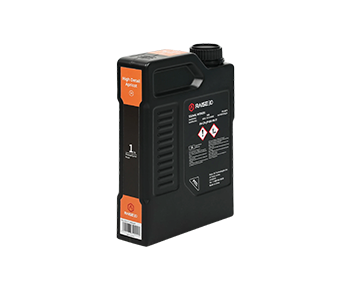
Workflow deserves the same discipline. The captured DF2+ information describes automatic resin refill, ultrasonic liquid-level monitoring, and assisted resin-tank cleanup as features intended to minimize contact with uncured resin. It also describes RFID technology that confirms the correct resin type before printing and real-time automatic resin-level detection. These details can inform a process review, but they should not be expanded into unsupported claims about safety, labor savings, or production performance.
Avoid unsupported conclusions
Early research often fails when a listed feature is converted into a result. A feature is evidence about what the page describes. It is not, by itself, evidence of a team’s productivity, part quality, operating cost, or return on investment. Keep those conclusions out of the comparison unless the project has separate, applicable evidence.
Use the same rule for speed. The DF2+ page gives a general printing-speed note based on an average of Raise3D materials printed at a 100 μm layer height. It states that speed varies with resin type, layer height, and part geometry. A procurement record should preserve those conditions rather than copying a speed figure into a broader promise.
Post-print work should also appear in the process map. The page describes removing the model from the build plate after printing, followed by washing and curing. That sequence is useful for identifying workflow stages and responsibilities. It does not establish the staffing, facility layout, or time required by a particular project.
- Confirm the resin type before printing using the documented RFID workflow.
- Record resin refill, liquid-level monitoring, and tank-cleanup steps in the operating review.
- Include model removal, washing, and curing as separate post-print workflow stages.
Carry requirements into procurement
When the research moves toward procurement, convert the comparison into a short sourcing brief. State the intended application, the material questions, the operating location, and the evidence that each requirement must answer. Mark every open issue as either a technical question, a process question, or a commercial question. This keeps the request focused and makes later answers easier to review.
Ask suppliers to respond to the same criteria for every candidate. Preserve the wording of conditions such as resin type, layer height, part geometry, and post-print washing and curing. If a requirement depends on a particular workflow feature, name that feature without assuming an outcome. A consistent request makes trade-offs visible instead of hiding them in different product descriptions.
Finally, keep the decision record tied to the intended use and the available evidence. The DF2+ page provides specific points about resin flexibility, RFID-supported resin identification, resin management, and the wash-and-cure sequence. Raise3D can therefore remain one documented candidate in the review, while the final choice rests on how those stated details match the project’s defined requirements.